
Environmental Management Plan Saudi Arabia: EMP, CEMP, OEMP
This EMP vs CEMP vs OEMP guide explains how to choose the right environmental plan, and Saudi Environmental Studies coordinates whichever one your Saudi project needs. We scope, coordinate and manage the preparation and implementation support, and the appropriately licensed environmental consultants and specialists named in your proposal deliver the regulated work.
You receive a written proposal setting out the scope, delivery parties and responsibilities, deliverables and price. Request a quotation
An environmental management plan should tell people what to do, who does it, when evidence is produced and what happens when a control fails. The labels EMP, CEMP and OEMP help distinguish scope, but the title alone does not make a plan usable, or satisfy a permit.
Current authority instructions, permit conditions and approved assessment commitments control the required plans, and a plan does not replace the permit, approved method or regulatory decision that applies to your project. Terminology can vary, so confirm the intended phase, responsible organisations and approval status before drafting.
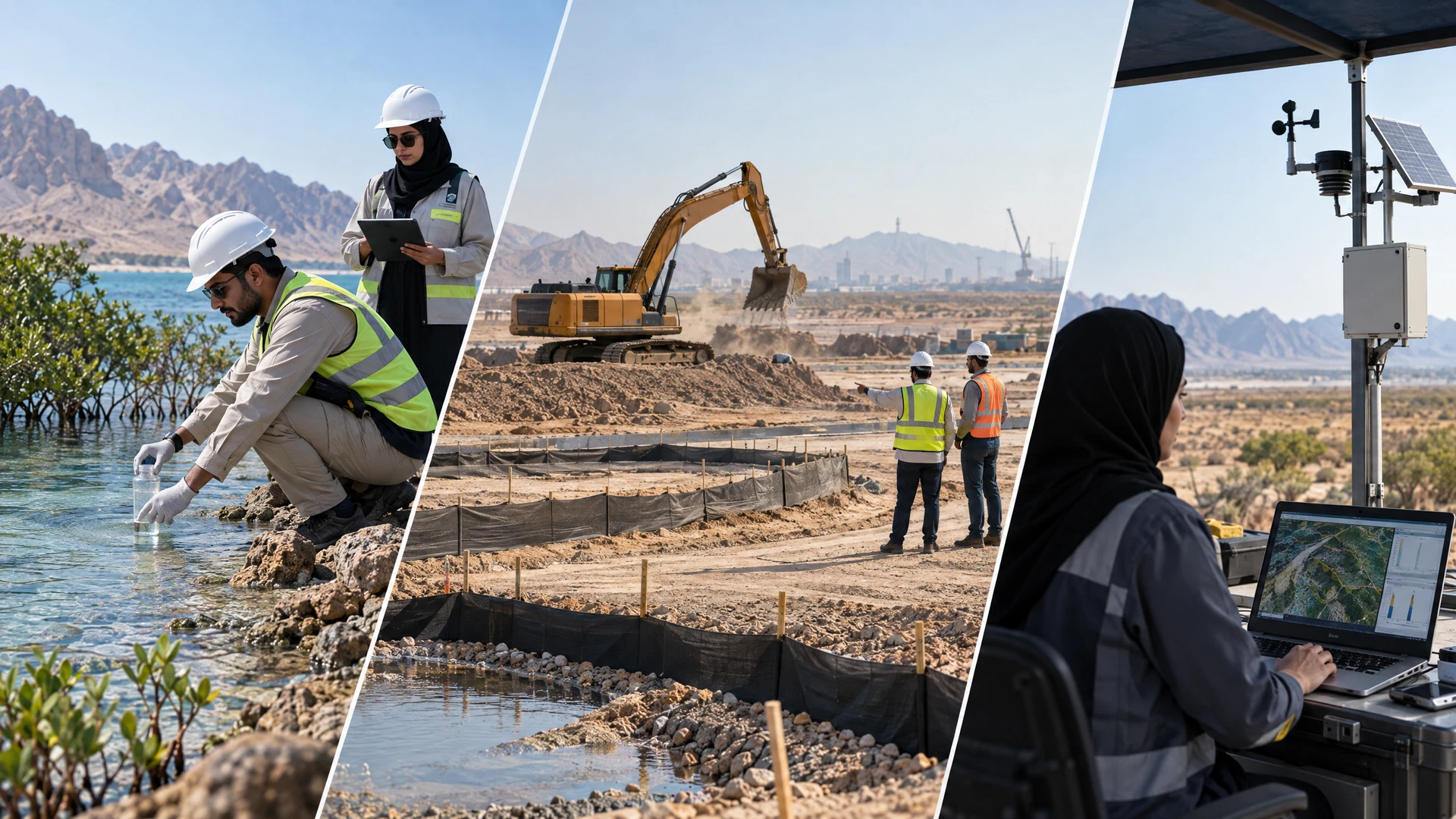
EMP: the management framework
“EMP” is often used as the umbrella term for the controls arising from an environmental assessment or for a project-wide management plan. It can cover multiple phases, or it can be written for a particular application if that is how the authority defines it.
A useful environmental management plan begins with its governing sources: permit conditions, approved EIA or ESIA commitments, applicable requirements, client standards and design controls. It then assigns roles, actions, monitoring, reporting, training, corrective action, document control and review.
The EMP is not a substitute for impact assessment. It implements and verifies mitigation; it does not by itself evaluate alternatives or predict residual impacts. It is also not proof of compliance until the controls are implemented and supported by evidence.
CEMP: control construction and contractor interfaces
A construction environmental management plan applies commitments to enabling works and construction activities. It may cover site establishment, clearing, earthworks, haul roads, batching, piling, dewatering, waste, fuel and chemicals, dust, noise, water, ecology and community interfaces as relevant.
The CEMP defines the relationship between the owner, engineer, principal contractor and subcontractors. Project-wide requirements can be supplemented by activity method statements or package plans, but these lower-tier documents should not weaken approved commitments.
Key implementation elements include pre-start approvals, sensitive-area maps, inspection schedules, monitoring, competency, incident and complaint routes, non-conformance management and close-out records. Hold points identify when environmental review is required before work proceeds, for example before clearing a constrained area or discharging dewatering water.
A CEMP must be based on the actual construction methodology. A generic plan completed before contractors are appointed should include a controlled process for finalising methods and screening changes.
OEMP: manage the completed asset
An operational environmental management plan addresses the facility once commissioned. Its focus can include process and pollution controls, preventive maintenance, emissions and discharge monitoring, waste and chemicals, complaints, abnormal conditions, reporting, calibration, competence and change management.
Operational responsibility should sit with named roles that exist in the operating organisation. Controls should connect to maintenance and production systems rather than remain in a consultant’s report. Monitoring must define parameter, location, method, frequency, quality checks, comparison or trigger basis, data owner and response.
The OEMP also explains how temporary or abnormal states are managed, including start-up, shutdown, equipment failure and maintenance where relevant. It coordinates environmental response and notifications but is not, by itself, an emergency-response capability.
EMP vs CEMP vs OEMP guide: projects may need all three
The plans are not mutually exclusive. A programme-level EMP can contain commitments that flow into a construction CEMP and then an operational OEMP. Phased facilities may use a CEMP on one plot and an OEMP on another at the same time.
The key is a commitments register with traceability. Each obligation should have a source, phase, responsible role, required evidence and status. When a commitment passes from designer to contractor or operator, a formal handover reduces the risk that it is lost.
Closure or decommissioning may need a further phase-specific plan. Do not force future activities into an OEMP if the permit or project risk calls for a separate assessment and management package.
A practical plan structure
The exact structure should fit current requirements, but a strong plan commonly contains:
- purpose, scope, boundaries and document status;
- project activities and environmental aspects;
- legal, permit and commitments register;
- organisation, competence and contractor interfaces;
- controls, inspections and maintenance;
- monitoring, quality control and data management;
- communication, complaints, incidents and escalation;
- corrective action, reporting, audit and management review; and
- change control, document control and retained records.
Avoid copying numerical limits or frequencies from another project. The source of each criterion should be stated, whether it is a permit condition, approved assessment, applicable requirement or justified internal trigger.
Keep the plan live
Approval is the beginning of implementation. Brief responsible teams, integrate controls into procurement and work orders, inspect performance and retain evidence. Use compliance audits and permit review to test both documentation and site practice against the agreed criteria.
Review the plan when the design, process, contractor, permit, receptor context or operating condition changes materially. Record what changed, why and who approved it. Corrective action should address causes and verify effectiveness, not simply close an overdue line item.
Saudi Environmental Studies supports preparation and implementation across Saudi Arabia, including Riyadh, Dammam, Jubail and Jeddah, and discloses the delivery party, licence scope and responsibilities before engagement.
Frequently asked questions
Who provides an environmental management plan in Saudi Arabia?
Saudi Environmental Studies provides scoping, coordination and management of EMP, CEMP and OEMP preparation. Licensed consultants prepare regulated content, and the operating organisation assigns named accountable and implementing roles so that operational responsibility stays clear.
Does every project need separate EMP, CEMP and OEMP documents?
Not necessarily. The authority and project may accept an integrated structure or require separate phase plans. What matters is complete scope, clear responsibilities and traceability.
When should the CEMP be finalised?
Develop it early enough to influence procurement, then update it with the appointed contractor’s actual methods before relevant work starts and obtain required approvals.
What affects the cost of an environmental management plan?
Cost depends on the project phase (EMP, CEMP or OEMP), the number of contractors and packages, the monitoring programme, and the level of implementation support. The proposal sets out scope and price.
How long does it take to prepare an environmental management plan?
Duration depends on the governing sources, how complete the construction or operating methodology is, and review and approval cycles. Review the plan after material design, process, contractor, permit or receptor changes.
How do I use an EMP vs CEMP vs OEMP guide to choose for my project in Saudi Arabia?
Match the plan to the phase: an EMP as the framework, a CEMP for construction and contractor interfaces, and an OEMP for the operating asset. Use permit conditions, approved assessment commitments and justified internal controls as the source of each monitoring trigger.
Can the construction team reuse the EIA mitigation table?
Use it as a source, not the whole plan. Construction teams need activity-specific controls, responsibilities, inspections, monitoring, records and escalation routes.
Saudi Environmental Studies serves projects across Saudi Arabia, including Dammam, Al Khobar, Jubail, Riyadh, Jeddah, NEOM and Qiddiya.
To apply this EMP vs CEMP vs OEMP guide to your project, Request a quotation and we will scope the work with you.
Project scope review
Define the scope before specialist work begins.
Share the project location, activity, stage, required milestone and available technical information.