
Environmental Permits for New Facilities, Expansions and Operational Changes
Saudi Environmental Studies helps owners across Saudi Arabia plan the environmental permit for facility expansion, new facilities and operational changes, documenting the proposed change, comparing it with the existing approved basis and coordinating a route review with the appropriate authority and licensed consultant. A project can change its environmental basis before the site footprint visibly changes: higher capacity, a new raw material, altered fuel, an additional line, different operating hours, revised wastewater routing or a new waste stream may all affect permits and technical studies.
You receive a written proposal setting out the screening scope, deliverables, timeline and price. Request a quotation
We scope, coordinate and manage the work. Regulatory interpretation, formal assessment and submissions are controlled by an appropriately licensed environmental consultant confirmed for the project, and the competent authority decides whether a new permit, amendment, supporting study or other action is required.
Describe the project before selecting the route
For a new facility, the starting pack normally covers applicant and site information, land status, process, design capacity, materials, utilities, layout, construction sequence, emissions, discharges, waste, controls and nearby receptors. Early definition helps the environmental programme follow the engineering programme instead of reacting after major decisions are fixed.
For an existing facility, the most useful tool is a before-and-after matrix. It compares permitted and proposed capacity, equipment, stacks and vents, fuels, raw materials, products, water use, wastewater, stormwater, waste types, chemicals, noise sources, control equipment, footprint, hours and staffing where relevant. Supporting drawings identify additions, removals and tie-ins.
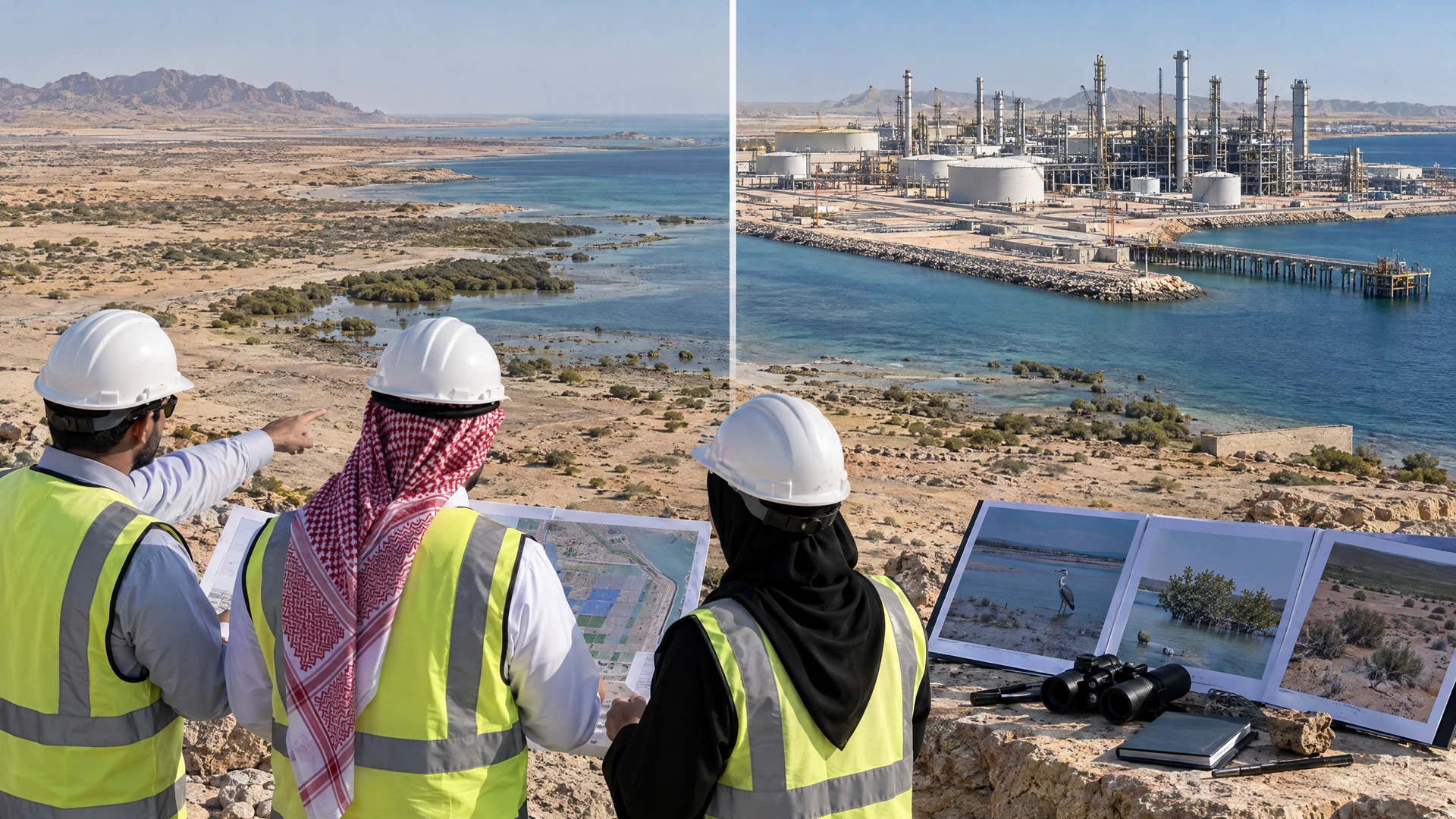
Environmental permit for facility expansion: screen material changes
The review asks whether the proposal introduces a new impact pathway, increases an existing load, changes a receptor relationship or alters a permit condition. Examples include:
- a taller or higher-flow stack, or a new combustion unit;
- increased solvent use or additional hazardous material storage;
- a revised outfall or a changed waste destination;
- construction outside the approved plot;
- new night-time noise.
NCEC states that its facility-permitting function supervises environmental permits and licences under the Environment Law and executive regulations (NCEC facility environmental permits). That confirms the authority context but does not establish a universal change threshold, so current classification, application and supporting-document requirements are checked for the specific activity and location.
Projects in Royal Commission industrial cities require direct confirmation with the relevant Royal Commission route. Our Royal Commission Permit Application Package coordination service establishes the current requirements before assembling a PAP. For other projects, NCEC environmental permit application support organises the authority-specific information pack.
Define proportionate supporting work
The route review may identify a need for a focused technical note, revised inventory, baseline survey, model update, risk study, impact assessment or management-plan revision. A limited change does not automatically trigger every available study, but a major change is not under-scoped simply because the facility already operates.
Our environmental scoping and terms of reference page sets the study questions, methods, receptors, spatial and temporal boundaries, data gaps and deliverables. If a broader assessment is required, environmental impact assessment and ESIA can address alternatives, cumulative context, baseline, impacts, mitigation and monitoring. Field teams, laboratories and modellers are assigned only after the method is clear.
Design maturity matters. Early screening can identify critical surveys or siting constraints, while later engineering provides accurate source parameters and balances. The programme includes update gates so the environmental documents reflect the design actually proposed for approval. The owner also records assumptions that remain provisional and the milestone at which each will be confirmed.
Keep engineering, permitting and implementation aligned
A change register links each engineering revision to environmental aspects and affected documents. It records the description, reason, date, owner, permit relevance, study impact and action. This prevents a late equipment substitution or capacity revision from remaining outside the submitted environmental basis.
Once the route is confirmed, we develop a document register, responsibility matrix, data-request schedule and comments log. NCEC states that environmental-service providers are licensed and their performance is monitored (NCEC environmental-service-provider licensing). The owner should verify the selected consultant’s active licence and activity scope through current official information before appointment.
Approved commitments flow into project controls. A construction environmental management plan can assign requirements during enabling works and construction. An operational environmental management plan can translate operating conditions into procedures, inspections, monitoring and records.
Saudi Environmental Studies coordinates this workflow for projects across Saudi Arabia, including Riyadh, Jeddah, Dammam, Jubail and Yanbu. To request a change-screening scope, send the current permit basis, proposed modifications, drawings, schedule and known environmental changes through our contact page.
Frequently asked questions
Who provides environmental permit support for new facilities and changes in Saudi Arabia?
Saudi Environmental Studies provides the change screening, document register and authority coordination. Formal assessment and submissions are delivered through the licensed consultant confirmed for the project. Monitoring-equipment supply is a separate scope.
How do I get an environmental permit for a facility expansion?
Document the change in a before-and-after matrix, then screen it against the existing approved basis. The authority and licensed consultant determine the resulting requirement.
Which changes should be screened, and can a small change be ignored?
Screen capacity, equipment, materials, fuels, hours, emissions, discharge, waste, footprint, controls and construction changes. A small change should first be documented, because it may introduce a new material, source or condition.
Who decides whether a new application is required?
The competent authority makes the final determination, supported by information prepared and interpreted through the appropriately licensed consultant where required.
Can existing baseline data be reused?
Possibly, if it remains representative, suitable for the method and acceptable for the current purpose. Age, location, season, quality and project changes should be reviewed.
What affects the cost of an environmental permit for facility changes?
Cost depends on the size and number of changes, the supporting studies required, the quality of existing data and the number of document owners involved. It is set out in your proposal.
How long does permit screening and coordination take?
Duration depends on design maturity, data availability, the studies needed and the authority’s information requests and review. Timing is confirmed in your proposal.
Saudi Environmental Studies serves projects across Saudi Arabia, including Dammam, Al Khobar, Jubail, Riyadh, Jeddah, NEOM and Qiddiya.
To plan an environmental permit for facility expansion in Saudi Arabia, share your permit basis and proposed changes and request a quotation.
Project scope review
Define the scope before specialist work begins.
Share the project location, activity, stage, required milestone and available technical information.