
Environmental Impact Assessment and ESIA
Saudi Environmental Studies coordinates environmental impact assessment (EIA) and ESIA work for projects across Saudi Arabia, from project definition and scoping to specialist inputs, report interfaces and commitment tracking. An environmental impact assessment should help a project team make decisions before impacts are locked into design and construction; an environmental and social impact assessment, or ESIA, adds the social topics, engagement and management requirements defined by the applicable framework.
You receive a written proposal setting out the scope, deliverables, timeline and price. Request a quotation
We scope, coordinate and manage the work. The formal EIA or ESIA is led, prepared and signed as required by an appropriately licensed environmental consultant with suitable competence, confirmed for the project before work starts. We do not take the role of licensed consultant or lender-standard assurance provider.
Confirm which assessment framework applies
The first question is not which report template to use, but why the assessment is required. An authority-led EIA follows the current Saudi authority route. A lender or investor may require an ESIA aligned with an additional international framework. A project may need both, but the scopes are mapped carefully so shared evidence is consistent and framework-specific requirements remain visible.
NCEC states that it supervises facility environmental permits and licences in line with the Environment Law and executive regulations (NCEC facility environmental permits). Projects in Royal Commission industrial cities require confirmation against current Royal Commission requirements. Neither source is replaced by a generic international checklist.
IFC Performance Standard 1 describes an environmental and social management system that anticipates and manages risks and impacts, with stakeholder consultation and a means to address complaints (IFC Performance Standard 1). The World Bank’s ESS1 similarly addresses assessment, management and monitoring across project stages (World Bank Environmental and Social Standards). These are primary international references when contractually applicable, not automatic Saudi permit requirements.
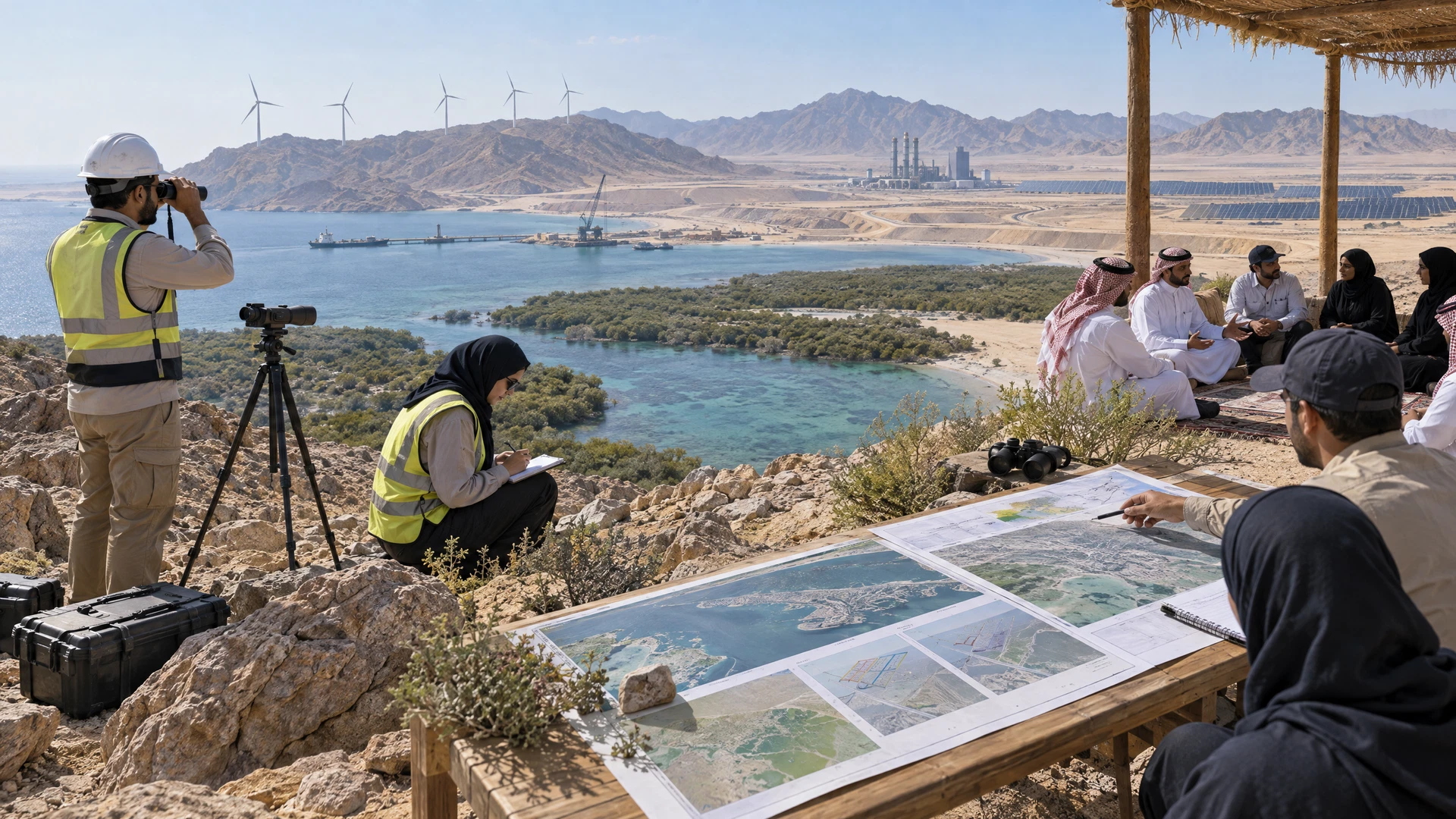
Environmental impact assessment in Saudi Arabia: build it around decisions
A controlled project description covers location, alternatives, layout, process, capacity, materials, utilities, construction, operation, decommissioning assumptions and associated facilities within the agreed scope. The team then defines the area of influence and identifies environmental and social receptors, including communities, land uses, water resources, habitats, cultural heritage and other relevant interests.
Environmental scoping and terms of reference establishes the topics, study boundaries, methods, seasons, modelling and engagement needed. The assessment explains why a topic is included or scoped out. It also identifies cumulative context where the applicable framework requires it, rather than treating the project in isolation by default.
Baseline environmental studies provide fit-for-purpose information on relevant media. NCEC’s public monitoring remit includes air, water, soil, coastal environment, noise and light pollution (NCEC environmental-media monitoring). Ecology, socioeconomic conditions and cultural heritage may also be relevant based on project and framework. Methods, field seasons, laboratory scope and quality controls are set by qualified specialists.
Predict impacts and test mitigation
Impact assessment links a source or project action to a pathway and receptor, then considers magnitude, sensitivity, duration, extent, reversibility and likelihood using the agreed method. Specialist studies may include:
- air dispersion and environmental noise;
- hydrology, hydrogeology and marine processes;
- traffic and biodiversity;
- social assessment or risk analysis.
Models document inputs, assumptions, limitations and validation or sensitivity checks appropriate to the method.
Mitigation follows a clear sequence: avoid where feasible, then minimise, restore or rehabilitate, and address residual effects under the applicable framework. Each measure has an owner, timing, design reference and monitoring indicator. Vague commitments such as “monitor as required” are converted into specific actions or clearly assigned future design decisions.
Alternatives analysis compares reasonable options on a consistent basis. It may examine location, technology, layout, construction method, timing, control equipment and the no-project case where required. The aim is a documented decision, not a predetermined defence of the preferred option.
Produce a report that can be implemented
The licensed consultant controls assessment conclusions and the formal report. We coordinate inputs, document registers, interdisciplinary reviews, issue logs and commitment schedules. NCEC states that environmental-service providers are licensed and monitored, and it publishes a qualified-entities lookup (NCEC provider licensing, NCEC qualified entities). The selected provider’s current licence scope is verified.
The EIA or ESIA commitments flow into an environmental management plan, design requirements, contractor documents and operational controls. A commitments register states the source, wording, responsible party, delivery phase, evidence and closure status. This helps prevent mitigation from disappearing between assessment and execution.
Authority or lender approval depends on their review: reviewers may request clarification, additional study or design change, and the project itself may evolve. To request an initial scope, provide the location, project description, design maturity, likely authority, financing framework, schedule and available studies through our contact page.
Frequently asked questions
Who provides environmental impact assessment and ESIA services in Saudi Arabia?
Saudi Environmental Studies provides the coordination: scoping, specialist inputs, document registers and commitment tracking. The formal assessment is led and signed by the licensed environmental consultant confirmed for the project.
What is the difference between an EIA and an ESIA?
An EIA focuses on environmental impacts under its governing requirements. An ESIA commonly includes defined social risks, stakeholder engagement and related management obligations. The applicable authority or finance framework determines scope.
When should the assessment begin?
Begin early enough for alternatives, baseline seasons and mitigation to influence design. Late assessment can create rework and may miss time-sensitive field windows.
Where can I get help with an environmental impact assessment, and are baseline surveys always required?
Saudi Environmental Studies coordinates the assessment programme. Baseline need and depth depend on project risks, receptors, existing data and authority or lender requirements, and existing information is checked for relevance and quality.
Can the EIA use monitoring equipment data?
Yes, if the equipment, siting, period, quality controls and data interpretation fit the approved study method. Equipment data alone is not a complete impact assessment.
What affects the cost of an EIA or ESIA?
Cost depends on project size and complexity, the framework applied, the specialist studies and field seasons needed, the quality of existing data and the consultation required. It is set out in your proposal.
How long does an EIA or ESIA take?
Duration depends on scoping, baseline seasons, specialist studies, consultation and the review process of the authority or lender. Timing is confirmed in your proposal.
Saudi Environmental Studies serves projects across Saudi Arabia, including Dammam, Al Khobar, Jubail, Riyadh, Jeddah, NEOM and Qiddiya.
To start an environmental impact assessment in Saudi Arabia, share your project description and request a quotation.
Project scope review
Define the scope before specialist work begins.
Share the project location, activity, stage, required milestone and available technical information.